
The State of Coaching 2026 — What 843 Vetted Provider Sites Actually Say
A first-party data study of the business-coaching supply — credentials, published pricing, and geography — computed from an evidence-gated corpus. Every figure is traceable to the cited script and input.
Most writing about the coaching industry runs on surveys and self-reports. This study runs on something harder: the published websites of the 843 vetted business coaches, consultants, and support organizations as of the July 2026 study snapshot in this directory, read through an evidence gate that keeps a claim only when it appears verbatim in the provider's own site text. A vetted provider is a real, operating coaching or consulting practice — confirmed against its public business footprint (a live website and/or an active Google Business Profile), human-reviewed as within the directory's advisory scope, and profiled only with facts its own published materials support: nothing on a profile is invented, and every claim is labeled by how it's evidenced.
Three ground rules before any number:
- Every figure is corpus-internal. These are statistics about the providers in this directory — a vetted sample concentrated in a few states (more on that below) — not estimates for the whole industry.
- Every figure is measured, labeled, and auditable. Each statistic below traces to a specific script over a specific filed artifact; the mapping lives in study-stats.tsv. Every figure is measured, labeled, and auditable. Each statistic below traces to a specific script over a specific filed artifact, and the full mapping is kept on file internally.
- Nothing here is taken on assertion. Credentials count only when the provider's own site evidences them; prices count only when the provider publishes them.
How the numbers relate. The directory holds 843 providers. Credential statistics are computed on the 663 providers with a completed evidence-gated site extraction. Credential statistics are computed on the 663 providers whose sites passed the evidence-gated extraction with at least one kept credential-class item. Of the 180 others: 158 sites were crawled and extracted but publish nothing in these categories that survives the gate, 21 were extracted in an earlier calibration pass reported outside this dataset, and 1 has no crawlable site.. Pricing statistics are computed on the 192 providers (of the 843) who publish at least one interpretable engagement price. Each section names its denominator; no percentage below refers to a base other than the one its section states.
Credentials: what providers actually evidence
The evidence-gated read of the 663 extracted sites produced 2,929 items across five groups — certifications, named programs, methodologies and assessments, professional roles, and education. A claim survived only if it sat verbatim in the provider's cached site text.
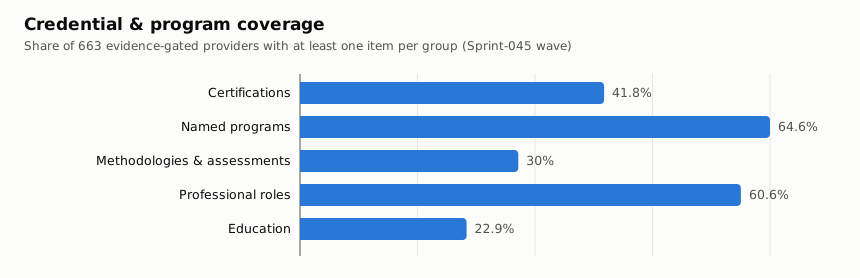
The shape is telling. Named programs lead: 64.6% of the 663 evidence a branded offering — providers are far more likely to present a productized program than a formal credential. Certifications appear on 41.8% of sites, and formal education on just 22.9%. That matters more than it might look: in a field with no licensing requirement, a certification is one of the few costly signals a coach can send — earning one demonstrates commitment to a system and a discipline, not just a marketing claim. That fewer than half of providers evidence one is itself a finding, and it makes the ones who do stand out.
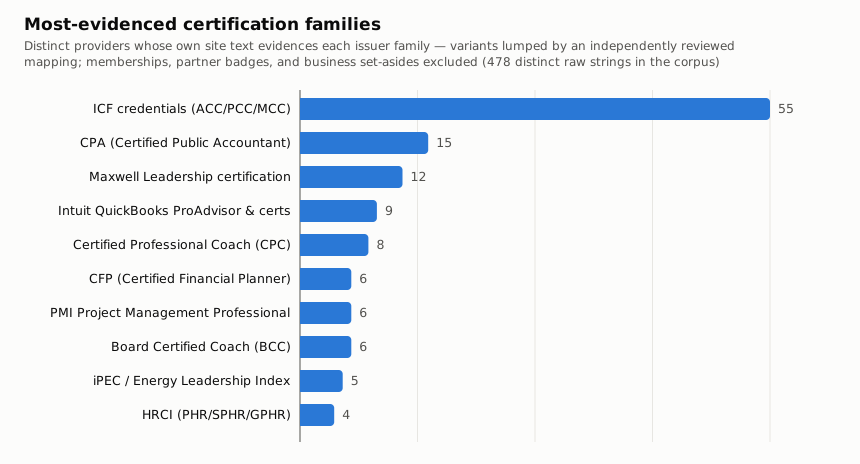
Lumping variant spellings into issuer families — a mapping reviewed string-by-string in an independent pass, with memberships, partner badges, and business set-asides excluded from the ranking — the International Coaching Federation's credentials lead by a wide margin: 55 providers evidence an ICF mark (PCC, ACC, MCC, or "ICF-certified"). The most-evidenced credential that isn't a coaching mark comes second: the CPA, at 15 providers — finance professionals repositioning as advisors. The rest of the top five tells the same productized story: Maxwell Leadership certification (12), Intuit QuickBooks certifications (9), and the Certified Professional Coach (8) — a distinct credential name, commonly iPEC's CPC, counted separately from the ICF's similarly worded Professional Certified Coach. Past the named families, the long tail rules: 478 distinct raw certification strings, most evidenced by exactly one provider.
Two category-level patterns sit underneath the family ranking. First, 45 of the certification mentions — 8.1% of that category — are unbranded coaching titles: "certified executive coach," "certified business coach," "certified master coach" — names with no issuer behind them. By the commitment yardstick above, a title nobody examined you for is a claim, not a credential. Second, the finance thread runs deeper than the CPA: business valuation, brokerage, and exit-planning credentials cluster 18 mentions (CBI, CVA, ABV, CDFA, CEPA and kin) — a whole category of advisors who help owners value, buy, and sell businesses, sitting inside a "coaching" directory because that's where owners look.
Pricing: what providers publish
A corpus-wide mine surfaced 6,614 price mentions across the 843 provider sites, from which 192 providers publish at least one interpretable engagement price. One honesty note applies to everything in this section: published prices skew productized and low-ticket — coaches with premium, scoped engagements usually don't post rates. Read these as floors of the published market, never as market-rate estimates.
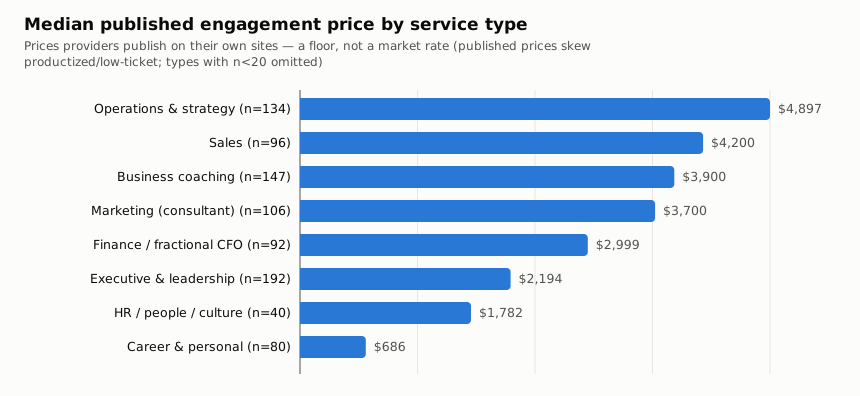
Among published prices, operations and strategy work carries the highest median ($4,897), with sales ($4,200) and general business coaching ($3,900) close behind. Career and personal coaching is the outlier at $686 — the one segment where productized, consumer-priced offers dominate what's published.
Geography: what the directory's map shows — and what it can't
An honest caveat leads this section: the directory's supply is concentrated. Texas (315), New York (298), and Virginia (203) together hold 816 of the 843 providers — 96.8% of the corpus — reflecting where the directory's sourcing began rather than where American coaching lives. So what follows is not a map of the national industry; it is a fine-grained map of three states' worth of it, and the town-level pattern inside those states is the finding.
That pattern is thin local supply. The 170 towns with at least one locally based provider are dominated by small counts: 81.2% of them (138 towns) have fewer than five local providers — too few, on their own, to give a local searcher a real comparison set.
So we asked the question the way a buyer would: from each town, how far do you have to widen the circle before you can compare at least eight providers?
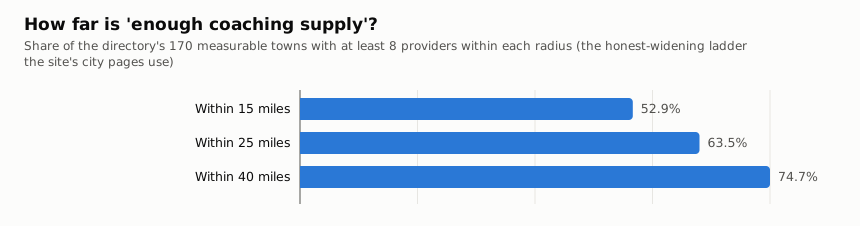
Just over half of directory towns (52.9%) reach eight providers within 15 miles. Widening to 25 miles lifts that to 63.5%, and to 40 miles, 74.7%. That leaves one town in four (25.3%) where even a 40-mile circle finds fewer than eight vetted providers. Yet proximity itself isn't the problem: the median distance from a directory town to its nearest out-of-town provider is 9 miles. Within this corpus, supply is nearby; discoverability is what's thin.
Methodology & provenance
- Corpus: the directory's 843 vetted providers (public export, 2026-07-09) and their evidence-gated site extractions; 831 carry usable coordinates, 9 use published town centroids, and 3 without a locatable town are excluded from distance math (840 locatable, 99.6%).
- Evidence gate: a value ships only when its supporting text appears verbatim in the provider's own cached site content; absent stays empty, never guessed. The gate's audit trail (zero fabrications) is on file.
- Auditability: every figure in this article maps to a row in an internal ledger naming its statement, value, honesty label, generating script, and input artifact. Re-running those scripts reproduces every number and chart; the ledger and artifacts are retained but not published.
- What this is not: an industry-wide survey, or a national map. It is a measured description of one vetted, geographically concentrated corpus — which is exactly what makes it checkable.
Questions about how a figure was computed? The provenance block below names every source this article derives from.
The 9-mile finding is why this directory's town pages now show honest nearby listings — each labeled with its own town and distance — instead of pretending small towns have no coaching at all. If you're searching from one of those towns, browse by location or start with the 3-minute interview.
- Was attributed to
- True North Vibe Editorial
- Was generated by
- Traceable corpus analysis — offline scripts over filed, evidence-gated artifacts; study-stats.tsv maps every figure to its script and input, 2026-07-09
- Was derived from
- Evidence-gated credential extraction, 663 providers / 2,929 items (widened-gated.json); Published-price corpus mine, 6,614 mentions (corpus-price-mentions.csv, internal-v-distribution.csv); Provider geography export, 2026-07-09, 843 providers (providers-export.json); Analysis scripts: study_credentials.py, study_pricing.py, study_geo.py, make_charts.py